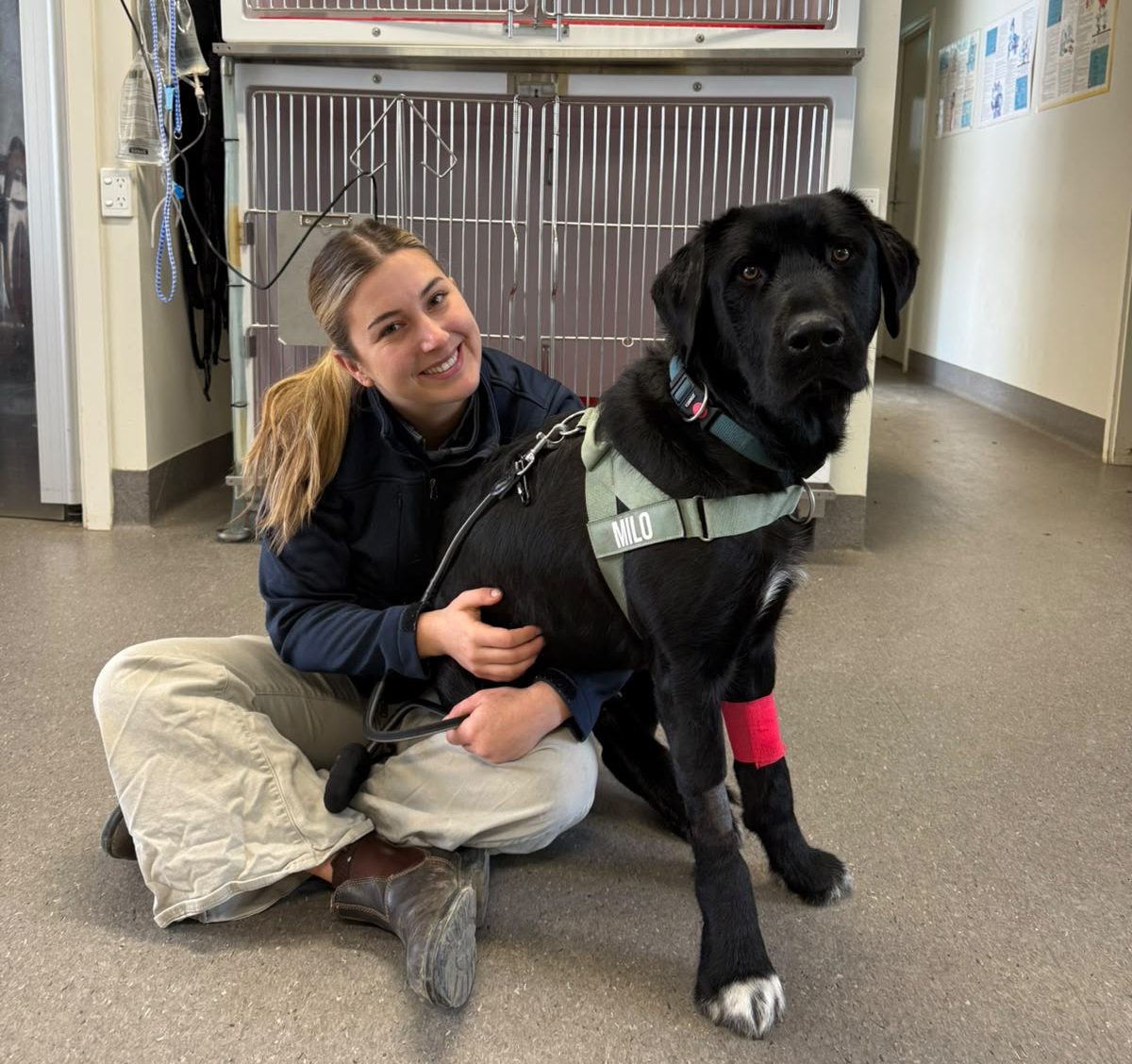
Milo’s Story: A Timely Reminder About Rat Bait
Milo recently came into the clinic after his owners noticed that he just wasn’t quite himself. He was a little flat, and his breathing seemed more laboured than usual. Although he was still eating, drinking and toileting normally, Milo’s owners knew him well and could tell that something wasn’t right. Sometimes, these subtle changes are the first indication that a pet is becoming seriously unwell.
When Milo arrived at the clinic, Dr Alexa agreed that his breathing appeared laboured. His respiratory rate was also higher than normal, so the first priority was to help him breathe more comfortably. Milo was placed on oxygen therapy to stabilise him while the team investigated what was going on. The next step was to take chest X-rays. The results gave Dr Alexa an important clue: there was a significant amount of fluid surrounding Milo’s lungs. In an otherwise healthy young dog in the Bungendore area during winter, one particular cause immediately came to mind—rat bait toxicity.
Why Is Rat Bait a Concern in Winter?
During the colder months, mice and rats often seek warmth and shelter inside homes, sheds and other buildings. Understandably, many people turn to rodenticides to control these unwanted visitors. Unfortunately, this can also create a risk for our pets.
Some rat bait packaging may suggest that the product is designed to be used safely around pets, but this does not necessarily mean that the bait itself is safe if eaten. Many dogs are surprisingly determined when it comes to finding something tasty, and rat bait can be particularly appealing to them.
Over the years, we have seen dogs find bait that owners were confident had been stored safely away—behind appliances, in cupboards or sheds, and even inside thick plastic containers. If a determined dog can smell it, they may go to extraordinary lengths to get to it!
There are several different types of rodenticides, but one group that can cause particularly serious problems in dogs is anticoagulant rodenticides.
When Dr Alexa asked Milo’s owners whether rat bait was being used around their home or property, they confirmed that it was. There was also a possibility that Milo could have had access to it. This made rat bait toxicity a very real possibility.
Putting the Pieces Together
To investigate further, Dr Alexa performed a coagulation panel to assess how well Milo’s blood was clotting. The results showed that Milo’s blood was taking significantly longer to clot than it should. Combined with his clinical signs, chest X-rays and possible access to rat bait, this confirmed the diagnosis.
Anticoagulant rodenticides work by interfering with the body’s ability to produce the clotting factors needed to stop bleeding. This means that an affected animal can begin bleeding internally or externally and may be unable to stop the bleeding normally.
Sometimes the first sign of a problem is bleeding into the chest, as happened with Milo. However, bleeding can occur in other areas of the body, including the abdomen or tissues. Even what would normally be a minor injury can potentially become much more serious when the blood is unable to clot effectively.
As bleeding continues, the animal can become severely anaemic and, without treatment, the consequences can be life-threatening.
The Good News: There Is an Antidote
Fortunately, anticoagulant rat bait toxicity can be treated with Vitamin K, which helps the body begin producing functional clotting factors again.
However, treatment is not always as simple as giving the antidote and immediately seeing an improvement. Vitamin K needs time to allow the body to produce new clotting factors, and during this period an affected patient may still be at risk of ongoing bleeding.
For some patients, particularly those who have already lost a significant amount of blood, additional support is needed.
In Milo’s case, he was significantly affected and required a blood transfusion.
A transfusion can provide much-needed red blood cells while also supplying clotting factors that help support the patient during this critical period. Essentially, it gives the patient valuable time while their own body begins to recover.
A Call to One of Our Heroes
Fortunately, our clinic maintains a list of eligible canine blood donors for exactly these situations—and many of those potential heroes happen to belong to our staff!
When Milo needed help, Jimmy, owned by our veterinary nurse Susie, got the call.
Jimmy came into the clinic and donated blood, helping provide Milo with the support he desperately needed. Thanks to his transfusion, along with ongoing treatment and monitoring, Milo responded well and was able to go home to his family later that evening to continue his recovery.
It was a wonderful outcome for Milo—and a reminder of just how important canine blood donors can be when an emergency arises.
Could Your Dog Be at Risk?
Milo’s story is a timely reminder to think carefully about whether rat bait is used around your home or property and, if so, exactly where it is placed and stored. Ask yourself: Could a determined dog get to it? Dogs are incredibly resourceful when food—or something that smells appealing—is involved. A container, cupboard or hiding place that seems secure to us may not always be secure enough for a curious and determined pet.
If you suspect your dog may have eaten rat bait, or if they are showing signs of weakness, lethargy, pale gums, difficulty breathing, unexplained bruising or bleeding, it is important to seek veterinary attention as soon as possible. Early intervention can make a significant difference.
And finally, if you have a healthy dog who weighs more than 25 kg, is under five years of age and enjoys visiting the vet, they may be eligible to join our canine blood donor list!
We are always looking for potential donors who could one day help save the life of another dog, just like Jimmy did for Milo. If you think your dog might be suitable and would like to find out more, please get in touch with our team.
A very special thank you to Jimmy—and well done to Milo and his family for recognising early that something wasn’t right. Sometimes trusting your instincts and acting early can make all the difference.
Love animals?
Get our news delivered to your inbox....
Subscribe to News
Our hours and location
- Monday 8am - 7pm
- Tuesday 8am - 5:30pm
- Wednesday 8am - 7pm
- Thursday 8am - 5:30pm
- Friday 8am - 5:30pm
- Saturday 9am - 1pm
All hours and every day,
we’re available on:
(02) 6238 1133
112b Molonglo Street Bungendore